How to Avoid Scuba Diving Panic Underwater: Complete Safety & Psychology Guide
Submerged in a high-pressure environment where human survival depends entirely on mechanical life-support equipment, the human nervous system faces unique physiological and psychological challenges. Underwater panic is rarely an isolated event. Instead, it is typically the culmination of a compounding sequence of small stressors, subtle environmental shifts, and unaddressed psychological tensions. Understanding the mechanics of stress escalation allows divers to interdict the cycle before it escalates into full-blown panic.
Preventing panic underwater requires more than a simple mental resolve to remain calm. It demands an integrated understanding of respiratory physiology, buoyancy control, environmental awareness, equipment familiarity, and situational communication. When a diver understands how psychological anxiety translates into physiological distress, they can systematically dismantle the feedback loops that lead to catastrophic decision-making underwater.
This manual provides a detailed analysis of underwater stress dynamics, psychological mitigation frameworks, real-world scenario management, and tactical intervention methods. By mastering these principles, recreational and technical divers alike can build deep situational resilience, ensuring safety and operational control across diverse diving environments.
Understanding “How to Avoid Scuba Diving Panic Underwater”
Understanding how to avoid scuba diving panic underwater begins with recognizing that panic is an involuntary primal response to perceived life-threat. The human brain is hardwired through evolutionary biology to prioritize immediate escape when oxygen supply seems threatened or when spatial disorientation occurs. In a terrestrial setting, sprinting away from danger is effective. Underwater, rapid ascent or thrashing movements directly increase the risk of arterial gas embolism, decompression sickness, and drowning.
The Anatomy of Stress Escalation
Panic rarely manifests out of nowhere. It usually follows a predictable progression often referred to as the stress buildup chain.
When an initial stressor occurs—such as mask flooding, a sudden cold thermocline, or a minor equipment issue—the autonomic nervous system activates a mild fight-or-flight response. Heart rate increases and breathing patterns shift from deep abdominal cycles to rapid chest breathing.
Physiological Feedback Loops
Rapid, shallow breathing alters gas exchange in the lungs. It increases dead-space ventilation, meaning carbon dioxide (CO2CO_2) is not effectively cleared from the respiratory tract. Elevated carbon dioxide levels in the bloodstream (hypercapnia) trigger the brain’s respiratory center to produce an intense sensation of air hunger.
At this stage, the diver feels as though their regulator is not delivering enough air, even if the breathing gas supply is fully functional. The perception of air starvation overwhelms cognitive reasoning, causing the diver to spit out their regulator or bolt toward the surface. Learning how to avoid scuba diving panic underwater requires interrupting this biological cascade before cognitive control is lost.
Psychological Misconceptions
A common misunderstanding in recreational diving is that panic is a character flaw or a sign of personal weakness. Divers often attempt to suppress feelings of anxiety due to peer pressure or fear of embarrassment. Suppressing anxiety without addressing the physical cause amplifies physiological stress. True panic management relies on early recognition, immediate physical mitigation, and open communication with dive partners.
Deep Contextual Background: Evolution of Diving Safety
The study of diver psychology and stress management has evolved significantly over the past century. Early open-circuit scuba instruction focused heavily on physical conditioning, task performance under stress, and military-style drills. While this produced resilient divers, it often overlooked the psychological nuances of human behavior under pressure.
Historical Shifts in Diver Education
During the 1960s and 1970s, as scuba diving transitioned into a popular recreational activity, training standards shifted toward accessibility. Certification courses became shorter, and equipment design improved dramatically with single-hose regulators, submersible pressure gauges (SPGs), and buoyancy control devices (BCDs).
However, early recreational training emphasized emergency procedures over stress prevention. Divers were taught how to respond to an out-of-air scenario, but rarely how to manage the cognitive overload that precedes such an emergency. Modern diving science recognizes that prevention strategies yield far better safety outcomes than reactive drills alone.
The Integration of Human Factors
In recent decades, aviation safety frameworks, such as Crew Resource Management (CRM), have been adapted for recreational and technical diving. Human factors research examines how spatial awareness, workload management, communication, and peer dynamics influence diver safety. Today, learning how to avoid scuba diving panic underwater is recognized as a fundamental skill set that combines mechanical competence with physiological self-regulation.
Conceptual Frameworks and Mental Models
To systematically address underwater stress, divers can utilize structured mental models that break down complex environmental interactions into manageable components.
The STOP-THINK-ACT Model
The STOP-THINK-ACT model is a foundational behavioral framework taught across major diving agencies to prevent panic.
1. STOP
The moment a diver senses discomfort, anxiety, or an unexpected mechanical change, all physical movement must cease. Continuing to swim while anxious consumes oxygen, elevates carbon dioxide levels, and increases physical work. Securing positive buoyancy or gripping a stable reference point stops movement and breaks the momentum of escalating stress.
2. THINK
Once movement has stopped, the diver shifts focus to internal assessment. The diver analyzes breathing patterns, checks depth and gas supply, and identifies the exact source of stress. Is the mask partially flooded? Is buoyancy negative? Is current increasing? By labeling the problem, the brain shifts from emotional reactivity to logical problem-solving.
3. ACT
Action is taken only after the problem has been identified and a deliberate solution chosen. Actions must be slow, measured, and repeatable. If an initial action fails to resolve the issue, the diver pauses, re-evaluates, and tries an alternative step without rushing.
The Task Loading Threshold
Task loading refers to the total volume of cognitive and physical demands placed on a diver at any given moment. Every diver possesses a finite cognitive bandwidth.
When environmental demands exceed cognitive capacity, the diver experiences task overload. Symptoms include tunnel vision, fixation on minor details, loss of buoyancy awareness, and sudden anxiety. Managing task loading involves dropping non-essential tasks—such as stowing a camera or pausing navigation—to restore mental capacity.
The Incident Pit Model
Developed by diving safety researcher Bernie Standard, the Incident Pit model illustrates how minor errors accumulate to trap a diver in an emergency.
Entering the pit occurs when small irregularities are ignored. A slightly ill-fitting mask, an improperly weighted BCD, and a mild current seem manageable individually. Combined, they push the diver deeper into the incident pit, making escape increasingly difficult. Recognizing the early stages of the pit allows divers to abort or adjust before panic sets in.
Key Stress Categories and Environmental Variations
Underwater stress originates from distinct internal and external sources. Understanding these categories allows divers to prepare targeted mitigation strategies.
Physiological Stressors
Cold water exposure triggers vasoconstriction, shivering, and elevated metabolic rates, which accelerate breathing gas consumption. Physical exertion against strong currents causes muscle fatigue and rapid CO2CO_2 buildup. Dehydration and poor physical fitness further decrease a diver’s stamina, making standard dive tasks feel overwhelming.
Environmental Stressors
Low visibility, pitch-black night conditions, overhead environments (caves, wrecks), and thermoclines introduce sensory challenges. In zero-visibility water, divers can quickly lose visual orientation, triggering spatial vertigo. The loss of a visible horizon forces reliance on instruments, which can elevate anxiety if instrument reading skills are unpracticed.
Mechanical and Equipment Stressors
Ill-fitting gear, unfamiliar rental equipment, or minor mechanical free-flows demand constant attention. A leaking mask valve or a stick buoyancy inflator button consumes cognitive energy. If a diver lacks complete trust in their life-support apparatus, minor operational fluctuations can provoke an extreme anxiety response.
Psychological and Social Dynamics
Peer pressure, often called “perceived social risk,” is a silent driver of diving accidents. Divers may agree to dives beyond their training or physical limits to avoid appearing inexperienced. Once underwater, the realization of being over-extended creates profound psychological anxiety, making the individual highly vulnerable to panic.
Detailed Real-World Scenarios and Decision Logic
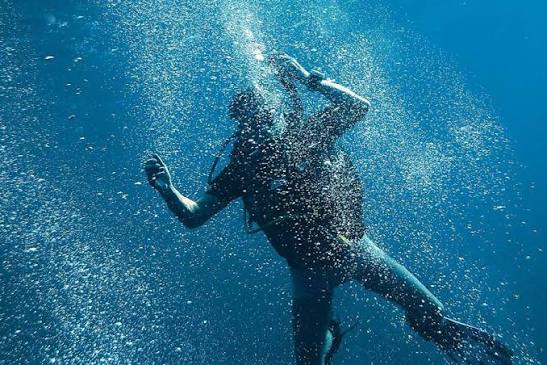
Analyzing real-world dive scenarios highlights how stress escalates and demonstrates practical ways to interdict the process.
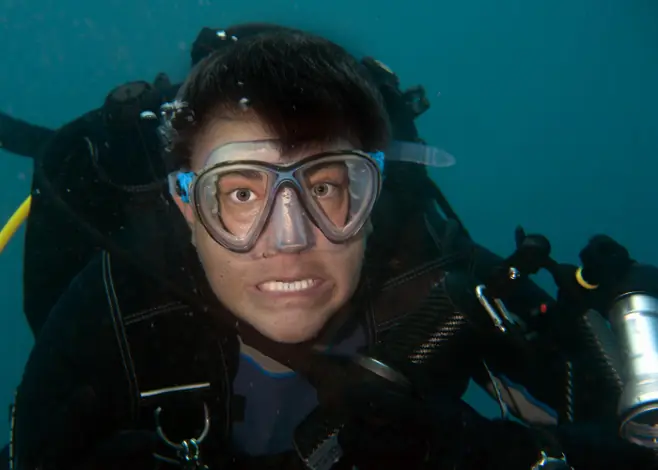
Scenario 1: Sudden Mask Displacement in Cold Water
A diver at a depth of 60 feet (18 meters) receives an accidental kick to the face from their buddy, dislodging their mask completely. The sudden influx of 50°F (10°C) water across the nose and eyes activates the mammalian dive reflex while simultaneously triggering a gasp reflex.
Decision Logic & Tactical Intervention
-
Immediate Reaction: The diver resists the urge to surface. They immediately close their eyes slightly, place one hand on the regulator second stage to secure breathing access, and take a controlled inhalation through the mouth.
-
Physiological Control: The diver exhales forcefully through the nose to clear water from the nasal passages, preventing water aspiration.
-
Equipment Correction: The diver locates the mask, repositions it on their face, seals the top skirt against the forehead, and clears the water by exhaling through the nose while tilting the head backward.
Scenario 2: Hypercapnia in a Strong Surface Current
A diver attempts to swim back to the dive boat against a unexpected 2-knot surface current. Exhausted, they begin breathing rapidly into their regulator, experiencing severe air starvation due to carbon dioxide retention.
Decision Logic & Tactical Intervention
-
Immediate Reaction: The diver recognizes hypercapnia and stops fighting the current.
-
Buoyancy Adjustment: They fully inflate their BCD using the low-pressure inflator or oral inflation valve to achieve positive buoyancy at the surface.
-
Regulator Management: They keep the regulator in their mouth until fully buoyant and stable, resisting the temptation to strip the mask or regulator off in a panic. Once stable, they signal the vessel for pick-up.
Planning, Cost, and Resource Dynamics
Preventing panic requires adequate preparation, equipment maintenance, and ongoing education. Investing time and resources into proper gear and training pays substantial dividends in safety and composure.
Equipment Selection and Personal Ergonomics
Ill-fitting or poorly maintained equipment is a primary cause of underwater frustration and stress. Investing in personalized equipment ensures comfort, streamline profile, and operational reliability.
-
Mask Fit: A leaking mask forces constant clearing, consuming cognitive bandwidth. Professional fitting eliminates mask flooding issues.
-
Regulator Performance: High-performance regulators deliver smooth airflow regardless of depth or breathing rate, reducing the likelihood of perceived air starvation.
-
Thermal Protection: Exposure suits must match water temperatures precisely. Overheating causes dehydration and anxiety; undercooling leads to shivering and loss of manual dexterity.
Tools, Strategies, and Support Systems
Divers can draw on clear physical protocols and mental tools to maintain composure during stressful underwater situations.
Physiological Control: Box Breathing Techniques
Breathing control is the primary physiological mechanism for arresting panic. When stress manifests, divers should employ structured, deep-breathing patterns to stimulate the parasympathetic nervous system.
By lengthening the exhalation phase, the diver ensures maximum carbon dioxide clearance from the lungs, resolving hypercapnic air hunger and lowering heart rate.
Systematic Pre-Dive Inspections
Equipment failure is a major catalyst for panic. Performing thorough pre-dive safety checks using standardized protocols eliminates mechanical surprises underwater.
Risk Landscape and Failure Modes
Understanding failure dynamics allows divers to spot compounding risks before they lead to an unrecoverable situation.
Compounding Risk Sequences
In diving, single points of failure rarely cause accidents. Instead, accidents stem from a cascade of minor errors. For example, a diver who is underweighted must use physical exertion to stay at depth. This exertion causes hypercapnia. If their mask then leaks, the combination of air starvation and nasal water contact can instantly trigger panic.
Spatial Disorientation and Blue Void Syndrome
Diving in open water without a bottom or surface reference can cause spatial disorientation. When sensory inputs fade, the brain struggles to determine up from down, triggering disorientation and panic. Using line references, monitoring depth gauges, or observing exhaust bubbles helps preserve spatial awareness.
Governance, Maintenance, and Long-Term Adaptation
Maintaining underwater composure is not a one-time achievement. It requires ongoing training, equipment care, and honest self-assessment.
Self-Assessment and Training Progression
Divers should log detailed notes on their physical state, air consumption, and comfort level after every dive. Sudden spikes in air consumption often indicate unaddressed stress or poor buoyancy trim. Identifying these signals early allows divers to adjust their habits before encountering a critical situation.
Measurement, Tracking, and Evaluation
Quantifying diving performance helps turn subjective feelings of anxiety into measurable metrics for improvement.
Calculating Surface Air Consumption (SAC) Rate
Monitoring SAC rate provides clear data on diver comfort. Elevated SAC rates directly correlate with physiological stress, exertion, or poor trim.
Tracking SAC rates over time helps divers confirm their growing comfort in different water conditions.
Common Misconceptions and Oversimplifications
-
Misconception 1: Panic only happens to beginners. Experienced divers can experience panic when facing severe task loading, cold shock, or unexpected gear failure.
-
Misconception 2: Holding your breath helps you calm down. Holding breath underwater increases CO2CO_2 retention and risks arterial gas embolism during ascents.
-
Misconception 3: Deep breathing means taking the biggest breath possible. Over-inflating the lungs increases chest tension. Effective breathing relies on deep, complete exhalations.
-
Misconception 4: Relying on a dive buddy completely prevents panic. Buddies offer critical support, but self-rescue capabilities are essential for safety.
-
Misconception 5: Pushing through anxiety builds mental toughness. Forcing through severe anxiety underwater usually leads to hypercapnia and increased panic risk.
Ethical, Practical, and Environmental Considerations
A diver’s psychological state directly affects the marine environment and overall team safety. An anxious diver thrashes their fins, damages delicate coral structures, stirs up silt, and reduces visibility for the whole group.
The Right to Abort
Every diver has the absolute right to abort any dive at any time for any reason without fear of judgment. Normalizing open communication about personal limits reduces social pressure and prevents preventable accidents.
Conclusion
Understanding how to avoid scuba diving panic underwater involves a combination of physiological management, technical preparation, and psychological awareness. Panic is not an unpredictable event; it is a physical reaction to escalating stress. By interrupting the stress cycle early—using structured models like STOP-THINK-ACT, maintaining respiratory control, verifying equipment integrity, and respecting personal limits—divers can remain calm and focused. Building these skills ensures safety, confidence, and peace of mind on every dive.